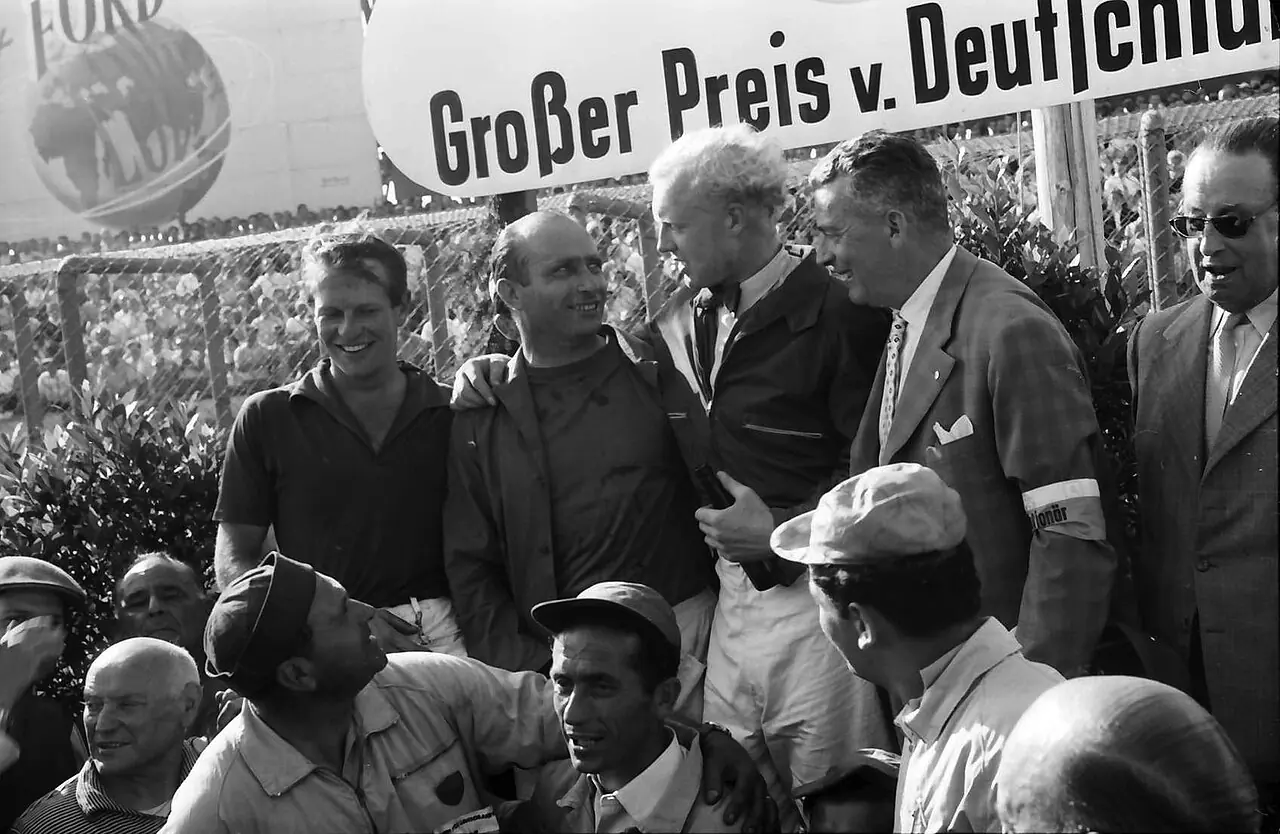
1950: eight for a win, but not every race counts
In the first world championship in 1950 only the top five scored: 8 for a win, then 6, 4, 3 and 2.1234 One more point went to the fastest lap, regardless of where the driver finished.1one source: 1
Not every result counted. From 1950 to 1953 only a driver's four best results were included.23 Luigi Fagioli scored 28 points over the seven rounds of 1950, but was credited with 24 in the table and finished third.120 The "best results" rule survived in various forms until 1990.134
The fastest-lap bonus was let down by the timing. At the 1954 British Grand Prix the same best time, 1:50, was credited to seven drivers, and each got one-seventh of a point. They included Juan Manuel Fangio, Alberto Ascari, Stirling Moss and Mike Hawthorn.421 Until 1958 drivers who shared a car also shared its points.1one source: 4
1960–1990: nine for a win and dropped scores
In 1960 a point was added for sixth place, and the fastest-lap bonus was dropped.4222 In 1961 a win went up to nine points.23423 In the constructors' standings that year, though, a win was still worth eight.1one source: 2 The nine-point scale lasted until 1990, longer than any other scale in F1 history.14
How many results counted changed almost every year. In 1979 the best eight counted: four from the first seven races and four from the last eight.24 From 1981 to 1990 the best 11 results counted, even though a season could have 16 races.24
Because of this, twice the champion was not the driver who had scored more points. In 1964 Graham Hill scored one point more than John Surtees, but had to drop his fifth place in Belgium and lost the title 39–40.1324 In 1988 Alain Prost scored 105 points and Ayrton Senna 94.13 But only the best 11 results counted, so Senna became champion on 90 points to Prost's 87.1425 By RaceFans' count, Prost dropped 18 points and Senna only four.1one source: 4
1991: ten for a win, everything counts
In 1991 the best-results rule was scrapped and a win became worth ten points. That scale was used until 2002.143239 Senna won the first four ten-point races in a row.426
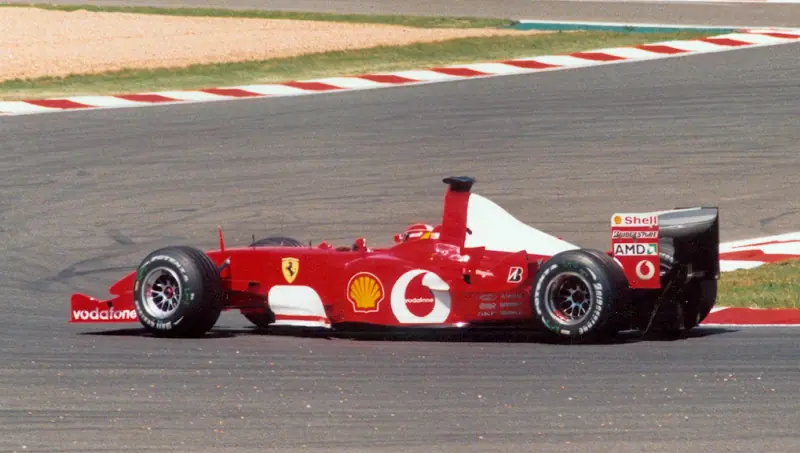
In 2002 Michael Schumacher sealed the title as early as the French Grand Prix on 21 July, with six rounds of the season to spare.427 Rubens Barrichello, second in the championship, finished 67 points behind him.128
2003: points down to eighth
From 2003 the top eight scored: 10, 8, 6, 5, 4, 3, 2 and 1.2529 Motor Sport and RaceFans link the change to Schumacher's dominance: second place was now only two points behind first.143 In 2003 Schumacher won his sixth title by two points from Kimi Räikkönen.130
2010: 25 for a win
In December 2009 the FIA announced a new scale for the top ten: 25-20-15-10-8-6-5-3-2-1.67 A month later the Sporting Working Group backed widening the gap between first and second to seven points.1one source: 6 Red Bull team principal Christian Horner said at the time: "I think you should never be afraid of change so long as it is a change for the better."1one source: 6 In early February 2010 the 25-18-15-12-10-8-6-4-2-1 scale was agreed, which the FIA said was meant to encourage "the race to win". On 12 February the FIA published the season's regulations with it.781
Abu Dhabi 2014: double points
In December 2013 it was announced that points for the final race of the 2014 season would be doubled.1one source: 9 According to AP, the idea was Bernie Ecclestone's: he wanted viewers to keep watching the championship until the last race.1one source: 10 Sky Sports writes that Ecclestone had originally wanted double points at each of the last three races.1one source: 9
Lewis Hamilton won the Abu Dhabi Grand Prix and received 50 points for it.315 AP calculated that Hamilton could have lost the title because of double points had Nico Rosberg won and Hamilton finished third.1one source: 10 But doubling did not change the champion: Hamilton would have won the title without it.139 In early December 2014 the FIA World Motor Sport Council scrapped double points.11101
2019–2024: a point for fastest lap
On 11 March 2019 the FIA announced that a point for fastest lap was returning. Only a driver classified in the top ten could get it, and another point went to his team. The FIA World Motor Sport Council approved the change on 7 March subject to an e-vote by the Strategy Group and the F1 Commission, which gave unanimous approval. It added 21 points to a season.1one source: 12 The bonus had last been awarded in 1959.234 The first to receive it was Valtteri Bottas: for his win and fastest lap in Australia he scored 26 points.1one source: 32
The bonus was most often taken with a late Pit stopA stop in the pits, most often to change tyres.In the glossary →: a driver with a big cushion over the car behind came into the pits for fresh tyres and set the best time.114 At the 2024 Singapore Grand Prix Daniel Ricciardo of RB did just that. He finished outside the top ten and scored nothing himself, but took the bonus away from Lando Norris and so helped Red Bull's Max Verstappen.1131437 In October 2024 the FIA announced that from 2025 there would be no fastest-lap bonus.13142
Sprints
Sprints arrived in 2021 at three events, and only the top three scored there: 3, 2 and 1.12333 In 2022 points were extended to the top eight: from 8 for a win down to one for eighth place.1334
Half points without a single lap
For shortened races a simple rule applied for a long time: points were awarded once two laps had been completed, and if less than 75% of the distance had been covered, half points.115 At the 2021 Belgian Grand Prix, because of heavy rain, the cars completed a few laps behind the Safety carA car that comes out after an accident and leads the field at reduced speed.In the glossary → only.1153 Max Verstappen got 12.5 points for the win and George Russell 9 for second, although there was not a single racing lap.351
After the criticism the rule was rewritten. From 2022 only laps under racing conditions count, and the points depend on how much of the distance has been covered. Up to 25%, the top five score on a 6-4-3-2-1 scale. Between 25% and 50%, the winner gets 13 points and the top nine score. Between 50% and 75%, the winner gets 19 points and the top ten score.35151
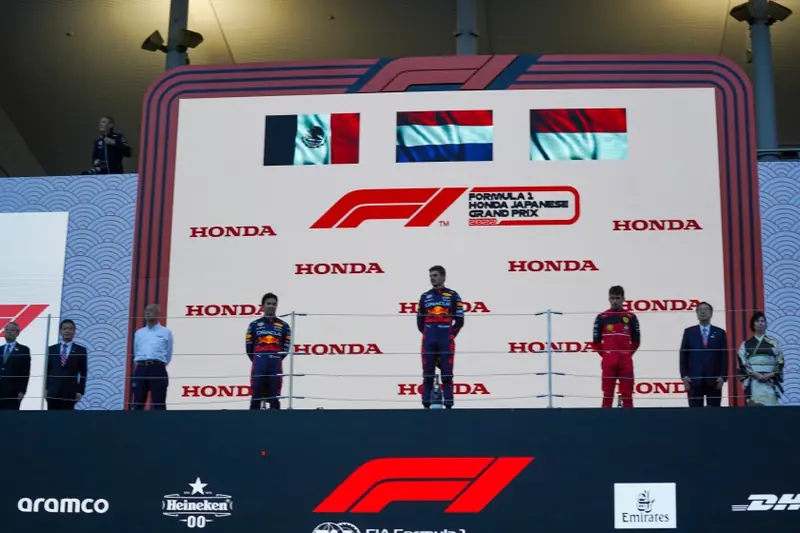
At its first big test the new system misfired. The race at Suzuka in 2022 was red-flagged, then restarted, and a little more than half the distance was completed by the finish.15161719 Teams expected the winner to get 19 points, but full points were awarded.1517 "The rules regarding the reduced points allocation (article 6.5) only apply in the event of race suspension that cannot be resumed," an FIA spokesperson explained.1one source: 16 Verstappen got 25 points and became world champion for the second time with four races of the season still to go.171936 In February 2023 the F1 Commission changed the wording to "ensure that shorter races have reduced points even if they don't finish with a suspended race".1819
What next
In spring 2024 Autosport reported a proposal to award points to the top 12 drivers.1one source: 3 Martin Brundle was against it: "Points must be hard won and treasured. Valued. Not some kind of lucky dip where everyone wins a prize."1one source: 3 The scale has not changed: at the 2026 Brazilian Grand Prix the winner received 25 points, only the top ten scored, and there was no longer a fastest-lap bonus.1one source: 38
Sources
Footnote numbers are the numbers of the sources in this list.
- Motor Sport Magazine, 2025-01-15: “F1 points system: how it works, and what's changed (Edward Hardy)”
- PlanetF1, 2025-01-04: “Explained: F1's points system and how drivers earned points in the past (Thomas Maher)”
- Autosport, 2024-04-25: “History of the F1 points system with proposed structure for 2025”
- RaceFans, 2009-12-22: “From 8 points for a win to 25: Every F1 scoring system (Keith Collantine)”
- Crash.net, 2025-08-31: “F1 points system: How are points awarded in 2025?”
- Autosport, 2010-01-25: “Teams agree to points system tweak (Jonathan Noble)”
- Reuters (via Al Jazeera), 2010-02-02: “F1 set to formalise points system”
- RaceFans, 2010-02-12: “2010 F1 rules published: FIA changes post-race penalties and fuel declarations (Keith Collantine)”
- Sky Sports, 2014-11-27: “F1's controversial double-points finale set to be scrapped in 2015”
- Associated Press (via Claims Journal), 2014-12-05: “Formula One Scraps Double Points, Reviews Safety”
- Adam Cooper's F1 Blog, 2014-12-03: “Standing restarts and double points officially canned by FIA (with the text of the FIA WMSC decisions)”
- FIA, 2019-03-11: “Championship point for fastest race lap returns to Formula 1”
- RTÉ, 2024-10-17: “Formula One to scrap fastest-lap bonus point from next season”
- Top Gear, 2024-10-18: “The FIA has scrapped F1's fastest lap bonus point for 2025”
- The Race, 2022-10-09: “The rule anomaly behind Verstappen's confusing F1 coronation (Matt Beer)”
- RaceFans, 2022-10-09: “Confusion as Verstappen declared champion after shortened Suzuka race (Keith Collantine)”
- Sky Sports (via CNBC), 2022-10-09: “Verstappen wins chaotic, rain-shortened Japanese GP to clinch title”
- RaceFans, 2023-02-21: “F1 tweaks flawed points rule, eases radio restrictions and approves new rain tyres (Keith Collantine)”
- Reuters (via TimesLIVE), 2023-02-22: “F1 rewrites the rule on shortened races”
- Jolpica F1 API, 1950: “1950 — final drivers' standings”
- Jolpica F1 API, 1954-07-17: “1954 British Grand Prix — results”
- Jolpica F1 API, 1960-02-07: “1960 Argentine Grand Prix — results”
- Jolpica F1 API, 1961-05-14: “1961 Monaco Grand Prix — results”
- Jolpica F1 API, 1964: “1964 — final drivers' standings”
- Jolpica F1 API, 1988: “1988 — final drivers' standings”
- Jolpica F1 API, 1991: “1991 — race winners”
- Jolpica F1 API, 2002: “2002 — race winners”
- Jolpica F1 API, 2002: “2002 — final drivers' standings”
- Jolpica F1 API, 2003-03-09: “2003 Australian Grand Prix — results”
- Jolpica F1 API, 2003: “2003 — final drivers' standings”
- Jolpica F1 API, 2014-11-23: “2014 Abu Dhabi Grand Prix — results”
- Jolpica F1 API, 2019-03-17: “2019 Australian Grand Prix — results”
- Jolpica F1 API, 2021-07-17: “2021 British Grand Prix — sprint results”
- Jolpica F1 API, 2022-04-23: “2022 Emilia Romagna Grand Prix — sprint results”
- Jolpica F1 API, 2021-08-29: “2021 Belgian Grand Prix — results”
- Jolpica F1 API, 2022-10-09: “2022 Japanese Grand Prix — results”
- Jolpica F1 API, 2024-09-22: “2024 Singapore Grand Prix — results”
- Jolpica F1 API, 2026-11-08: “2026 Brazilian Grand Prix — results”
- Jolpica F1 API, 1991-03-10: “1991 United States Grand Prix — results”