A race over two days
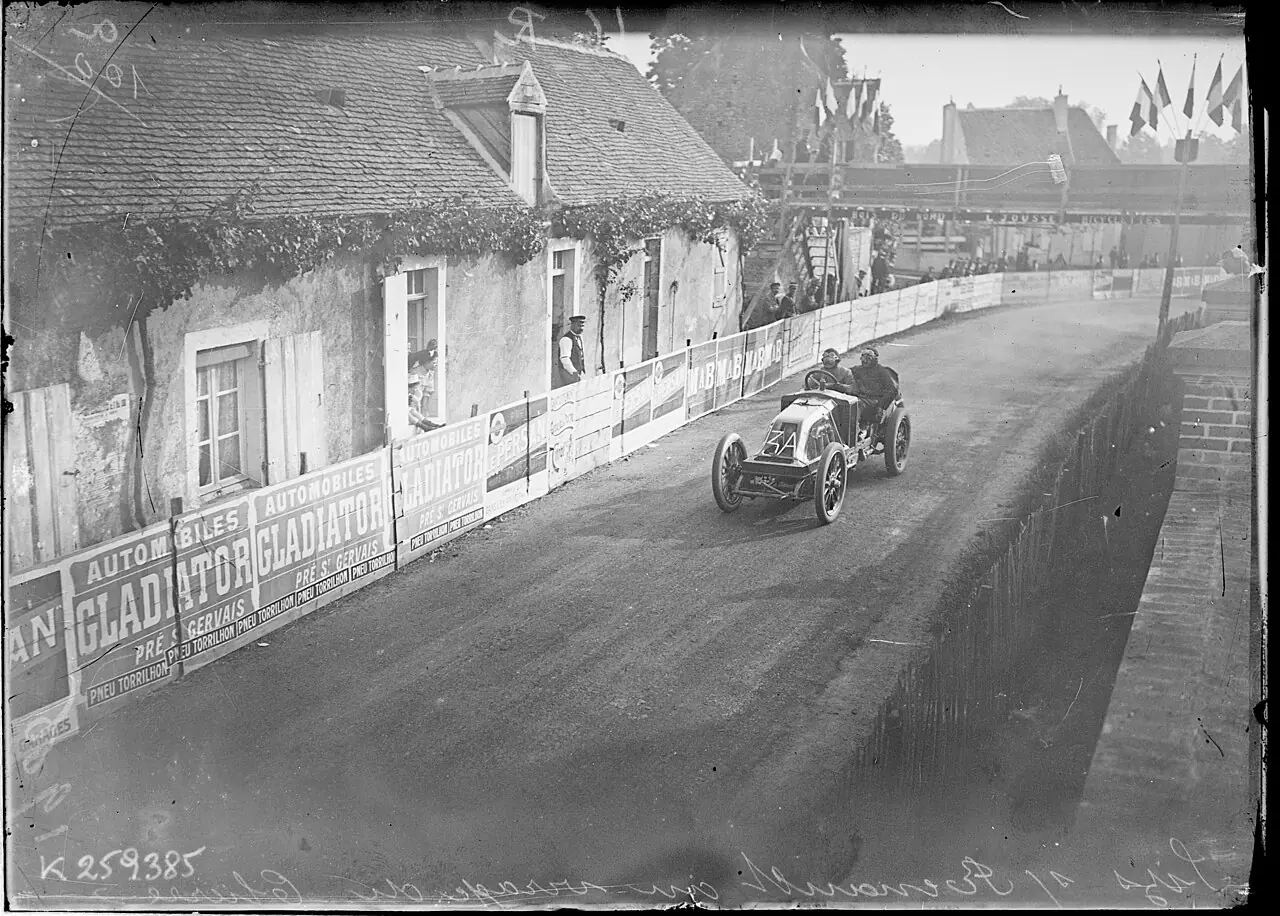
The 1906 race of the Automobile Club de France is regarded as the first Grand Prix in history, and its winner as Grand Prix racing's first winner.32 The cars set off on roads near Le Mans on 26 June and finished the following day.53 The new race took over from the prestigious Gordon Bennett Cup: the distance was doubled and spread over two days.1one source: 3
One lap was about 64 miles, roughly 103 km.1one source: 34 In total the field had to cover 769 miles, more than 1,200 km.1one source: 4 Thirty-two cars started.1one source: 4 The fastest lap went to Paul Baras in a Richard-Brasier, at an average of more than 73 mph.1one source: 43
The winner was the Hungarian Ferenc Szisz in a Renault.254 He spent a little over 12 hours at the wheel.1one source: 5 Felice Nazzaro finished 32 minutes later, and Albert Clément arrived three minutes after him.1one source: 3 Renault saved plenty of time with Michelin's detachable rims: according to Motor Sport, a rim could be changed in four minutes, against 15 to change a tyre and tube.1one source: 3
A championship won by the last man
Between the wars Grand Prix racing already had a championship of its own. From 1931 the Association Internationale des Automobile Clubs Reconnus (AIACR) ran a European Championship.18 Historian David Tremayne, writing on F1's official website, calls it "a World Championship in all but name".1one source: 1
Its points worked the other way round. A driver who completed more than 75% of the distance got four points, while one who covered a quarter of the race or less got up to seven. The champion was whoever had the lowest total.1one source: 1 Its champions included Tazio Nuvolari, Rudolf Caracciola and Bernd Rosemeyer, and the Second World War brought it to an end.1one source: 1
What "formula" means
In 1946 the AIACR's sporting commission, known as the CSI, set about rebuilding motor racing and began discussing new Grand Prix rules.1one source: 1 "Formula" here means a set of rules that a car in a given class has to meet. At first the new class had no official name: Formula Internationale, Formula A and Formula I were all used.16 In the end the name Formula 1 stuck, because it made clear straight away that this was the premier formula.17
Two types of engine were allowed: normally aspirated units of up to 4.5 litres, or 1.5-litre supercharged ones.167 When exactly the rules were adopted, though, the sources disagree. According to Tremayne and Goodwood, they were drawn up in 1946 to apply from 1947. Peter Higham's book, in an extract published by RaceFans, says otherwise: the CSI met in October 1947 and announced rules for 1948–1953.?sources disagree: 167 According to Goodwood and RacingNews365, the new rules were first used as early as the 1946 Turin Grand Prix, which Achille Varzi won in an Alfa Romeo 158.68
The idea of an official world championship is generally credited to the Marquis Antonio Brivio, Italy's representative at the FIA.17 In 1949 it was confirmed that the first Formula 1 World Championship would start in 1950, with the champion decided at the end of the season.1one source: 1
Royal Silverstone
The new championship's first round took place on Saturday 13 May 1950: the British Grand Prix at Silverstone.18912 The race also carried the honorary title of Grand Prix d'Europe.19 The track was laid out on a former Second World War military airfield.189
King George VI, Queen Elizabeth and Princess Margaret came to watch.18109 It was the first time a reigning monarch had attended the race, so it became known as "Royal Silverstone".1one source: 1 The size of the crowd is uncertain: Motorsport.com puts it at about 150,000, the PA news agency at 200,000.?sources disagree: 910
Twenty-one cars started: alongside the Alfa Romeos there were five Talbot-Lagos, six Maseratis, four ERAs and two Altas.112 Ferrari did not come to Britain.17 The British hope, the V16-engined BRM, was not yet ready to race; team founder Raymond Mays only gave the car a demonstration run during the meeting.17 Alfa Romeo entered four 158 "Alfettas".19 The model had been designed by Gioacchino Colombo before the war for the voiturette class.711 Alfa Romeo had sat out the 1949 season after losing Achille Varzi, Jean-Pierre Wimille and Count Carlo Trossi.17
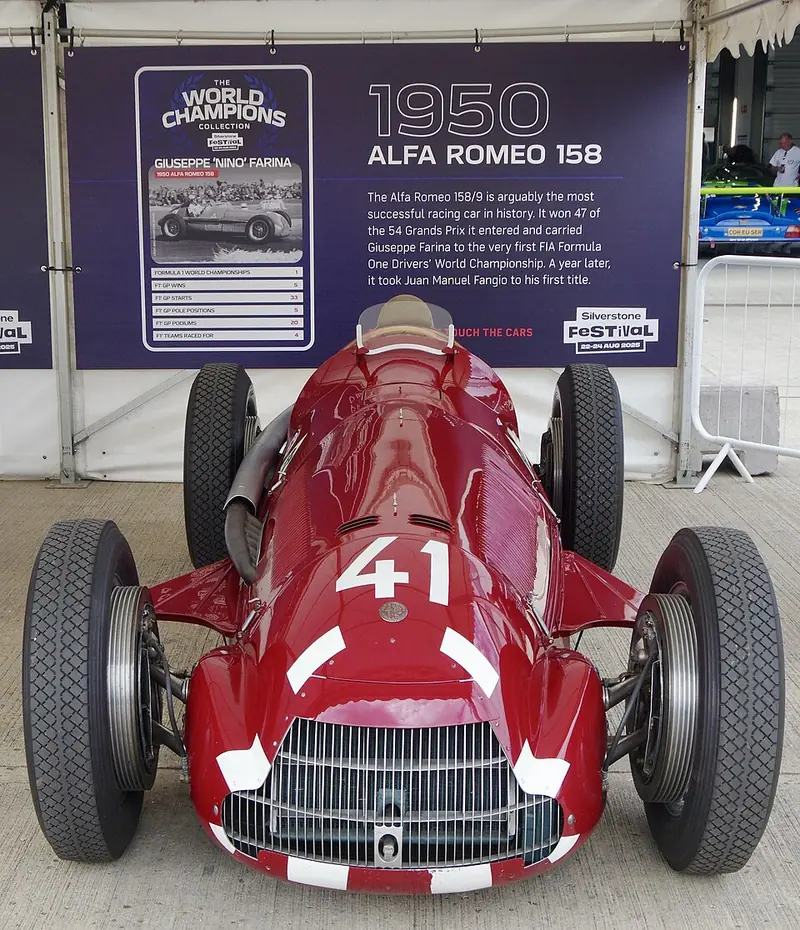
The regular drivers, Giuseppe Farina, Luigi Fagioli and Juan Manuel Fangio, were dubbed the "three Fs". The fourth car went to Briton Reg Parnell, because Consalvo Sanesi was injured.971 All four Alfa Romeos lined up on the front row, with Farina on Pole positionFirst place on the grid. It goes to the fastest driver in qualifying.In the glossary →.10712
In those days only the top five scored: 8, 6, 4, 3 and 2, plus one point for fastest lap.178 The "three Fs" ran together and swapped places at their mid-race fuel stops, but Farina led most of the distance, around 63 of the 70 laps.1one source: 9
Fangio retired eight laps from the end with an oil-line problem.71012 Farina won the 70-lap race 2.6 seconds ahead of Fagioli.129 Parnell finished third, despite hitting a hare on track during the race.9107 Farina got 8 points for the win and one more for fastest lap.1289 The King left before the finish and did not present the trophies.1one source: 9
The sources do not agree on the prize money either. Motorsport.com writes of £1,750 in prize money. Tremayne, on the other hand, reckons the whole fund was unlikely to have exceeded £1,000, with around £350 going to the winner.?sources disagree: 91
Indianapolis among the Grands Prix
The first championship had seven rounds: Britain, Monaco, the United States, Switzerland, Belgium, France and Italy.1913 The US round was the Indianapolis 500.1913 Tremayne explains that it was included as "a political ploy designed to give the series a suitably international flavour". In practice Grand Prix and Indianapolis drivers hardly crossed over until Jack Brabham took a Cooper there in 1961.1one source: 1
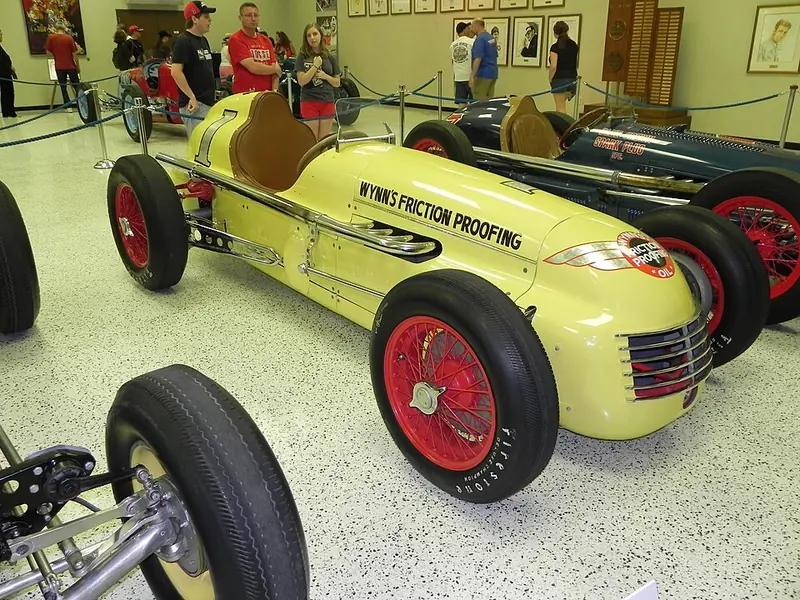
The Indianapolis 500 was part of the world championship up to and including 1960.1715 The first Indy 500 to count for the championship, in 1950, was won by Johnnie Parsons in a Kurtis Kraft.1one source: 13
The first champion
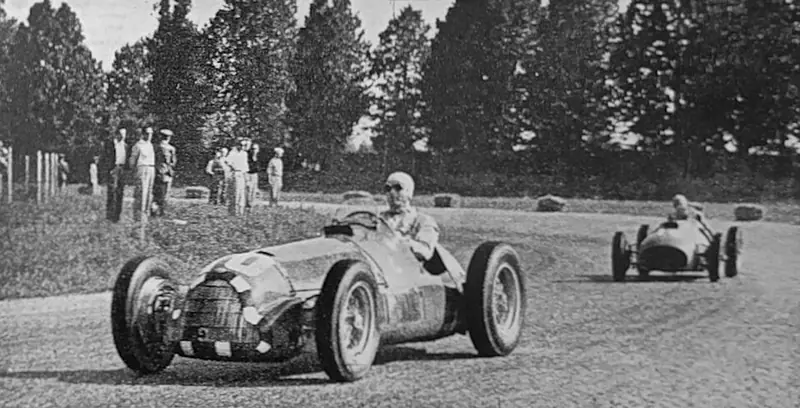
All six European rounds of the championship that year were won by Alfa Romeo drivers.137 Farina and Fangio took three wins each.1113 The title was settled at the final race at Monza, and Farina won it.110117 For that race Alfa Romeo gave him an upgraded car, dubbed the 159.117 Monza also saw the Ferrari 375 appear in its final form with a 4.5-litre normally aspirated engine, and Alberto Ascari finished second in Dorino Serafini's car. In Motor Sport's assessment, Alfa Romeo would face a serious challenge in 1951.1one source: 11 Farina scored 30 points to Fangio's 27, and so Farina became Formula 1's first world champion. Fagioli completed the top three on 24 points, and all three drove for Alfa Romeo.14108
Only the drivers' title was contested then; the constructors' championship did not arrive until 1958.116
Where the sources disagree
David Tremayne on Formula1.com writes that the CSI voted for the new formula in 1946, with the rules formally in force from 1947; Goodwood that they were drawn up in spring 1946 for racing from 1947. Peter Higham's book, in an extract published by RaceFans, says the CSI met in October 1947 and announced rules for 1948–1953. [1, 6, 7]
Sources
Footnote numbers are the numbers of the sources in this list.
- Formula 1 (formula1.com), 2020-05-13: “Why is it called Formula 1 – and 12 other questions about the championship's origins (David Tremayne)”
- Formula 1 (formula1.com), 2025-08-03: “TREMAYNE: How Hungarian driver Ferenc Szisz became Grand Prix racing's first winner”
- Motor Sport Magazine, 2024-03-20: “Track visit: Le Mans 1906 (Marcus Simmons)”
- Motor Sport Magazine (database): “1906 French Grand Prix — race database”
- Automobile Club de l'Ouest (24h-lemans.com), 2016-11-28: “Today's Photo Story — ACF Grand Prix in 1906, the first race at Le Mans”
- Goodwood Road & Racing, 2025-05-21: “The first F1 race: 1946 Turin Grand Prix (Simon Ostler)”
- RaceFans, 2020-05-13: “Extract: The birth of the F1 world championship, 70 years ago today (Peter Higham, 'Formula 1 Car by Car 1950-59')”
- RacingNews365, 2025-05-13: “F1's first grand prix revisited on landmark 75th birthday”
- Motorsport.com, 2020-05-13: “Remembering F1's first world championship race 70 years on (Adam Cooper)”
- PA Media (via PlanetF1), 2020-05-13: “70 years on: F1's first World Championship race”
- Motor Sport Magazine (database): “1950 F1 World Championship — overview”
- Jolpica F1 API, 1950-05-13: “1950 British Grand Prix — results”
- Jolpica F1 API, 1950: “1950 season — race winners”
- Jolpica F1 API, 1950: “1950 season — final drivers' standings”
- Jolpica F1 API, 1960: “1960 season — calendar”
- PlanetF1, 2025-01-04: “Explained: F1's points system and how drivers earned points in the past (Thomas Maher)”