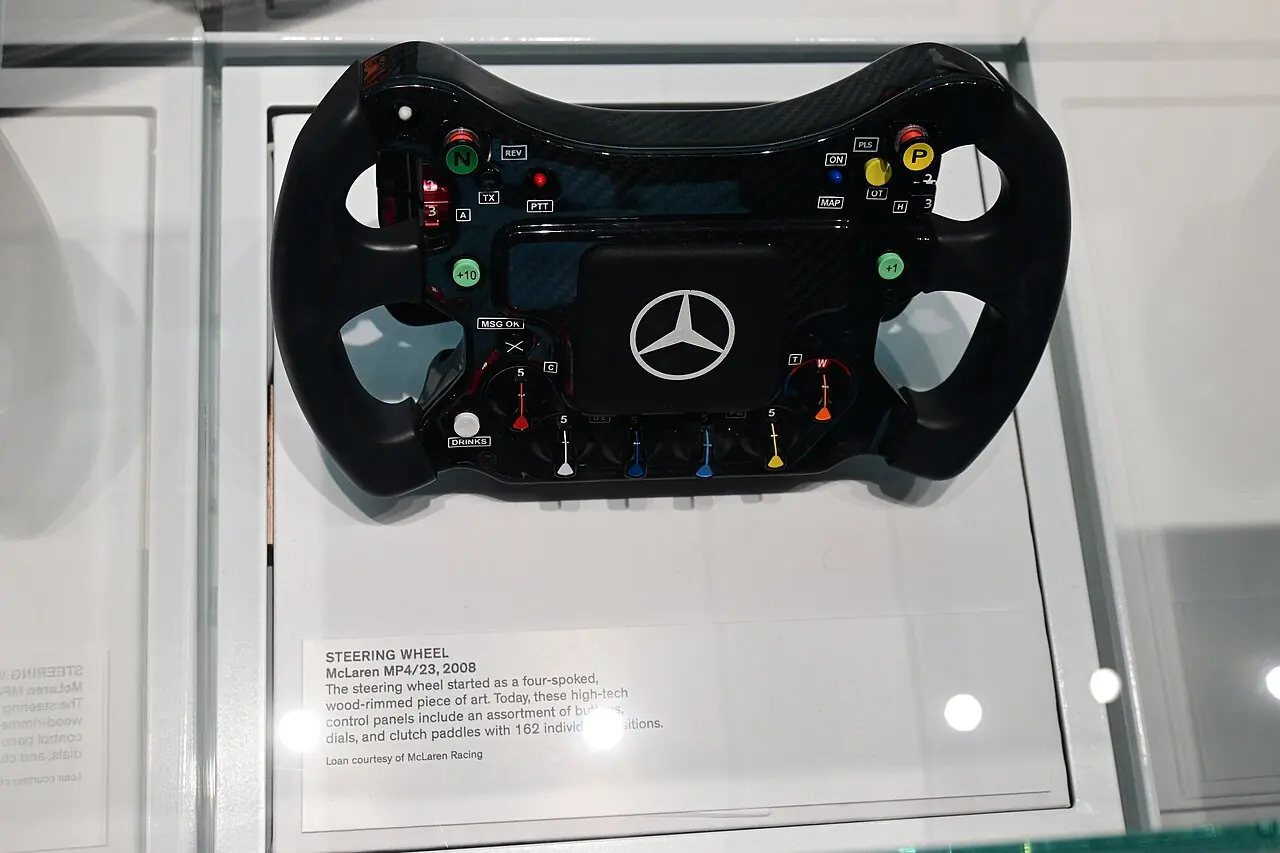
A control panel, not a hoop
An F1 car's steering wheel stopped being just a steering wheel long ago. Mercedes counted 25 buttons and switches on its 2019 wheel, plus the clutch and gearshift paddles.1one source: 1 Motor Sport counted differently in 2025: the wheel is built around standard McLaren Applied electronics, which allow up to 20 buttons, nine rotary switches and six paddles. What each button actually does is up to the team.1one source: 5
What is on it
Every team has its own layout, but the set of controls is similar.14
Brakes. On the Mercedes, five buttons and switches handled the brakes: the balance between front and rear axles, engine braking, and so-called brake migration, in which the balance changes depending on how hard the driver presses the pedal.124 The driver tweaks the balance for specific corners.12
Differential. Another three switches on the Mercedes control the differential, meaning how torque is split between the rear wheels, separately for corner entry, ApexThe point of a corner where the car is closest to the inside edge.In the glossary → and exit.124 On the Ferrari SF90 wheel these are two rotaries, DIF IN and DIF MID, and drivers turn them several times a lap.12
Engine. Mercedes considered the "Strat" switch the most important: it sets the Power unitThe combustion engine together with the electrical part and the battery.In the glossary → modes, meaning engine performance and the deployment and recovery of electrical energy. Which mode to use is usually what the engineer tells the driver over the radio.1one source: 1 On the Ferrari the same job is done by "Manettino" switches, large rotaries like those on Ferrari road cars. Among them is "Grip", used at the start to set clutch slip, and a separate mode for the Safety carA car that comes out after an accident and leads the field at reduced speed.In the glossary →.1one source: 2
Everyday buttons. On the SF90, "N" selected neutral and "P" the Pit laneThe separate road along the pits. A speed limit applies there.In the glossary → speed limiter. There were buttons for the radio, DRSDrag Reduction SystemA rear-wing flap a driver could open on set straights when less than a second behind the car ahead. Used from 2011 to 2025.In the glossary →, an additional oil pump, the drinks bottle and confirming an instruction from the pit wall. Lights beside the screen repeat the marshals' flags.1one source: 2
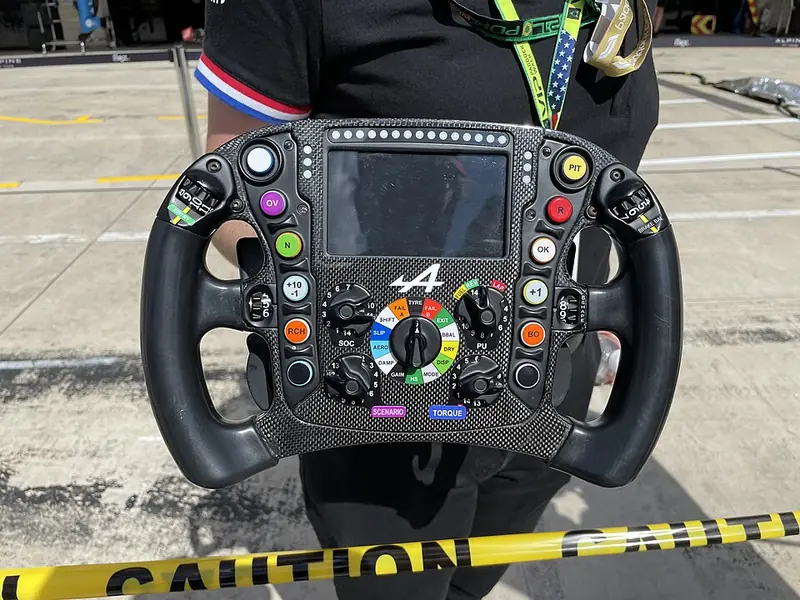
Paddles. Gears are changed with two paddles behind the wheel, usually left for down and right for up.1one source: 4 On a lap of Melbourne a Mercedes driver changed gear around 50 times, with a row of 15 LEDs above the screen showing the moment to shift.1one source: 1
What it is made of and what it costs
Mercedes named the main materials: carbon fibre, fibreglass, silicon, titanium and copper. They make up several hundred individual parts. The team built nearly everything itself in Brackley, apart from the central display and the circuit board beneath it: those are the same for every team.1one source: 1 The body is carbon, the grips silicone.15
The wheel is fitted to the individual driver's hands and is reworked even in mid-season.14 Back in the 1980s Nigel Mansell, who put a lot of force through the wheel, asked for thicker grips, while Ayrton Senna, with his smoother style, wanted the opposite.1one source: 4 To avoid hitting the wrong thing in gloves and through the vibrations, Mercedes used aircraft-grade buttons with a stiff action and small plastic rims around some buttons. They helped most at the Monaco hairpin, where the wheel goes to full lock.1one source: 1
Each Mercedes driver got three to four wheels a season, and building one took around 80 hours.1one source: 1 Teams do not publish prices, so there are only estimates: $50,000 (£35,000) from Motor Sport in 2025, €50,000 (£43,000) from PlanetF1 in 2023 and £50,000 from Motorsport.com.?sources disagree: 567
How it got this way
In the 1960s the wheel of the McLaren M7C had one function: turning left and right.34 The first switch arrived in the mid-1970s, an emergency ignition kill. The throttle slides of the time could jam open if dirt got into the mechanism, and the driver had to shut the engine off quickly.34
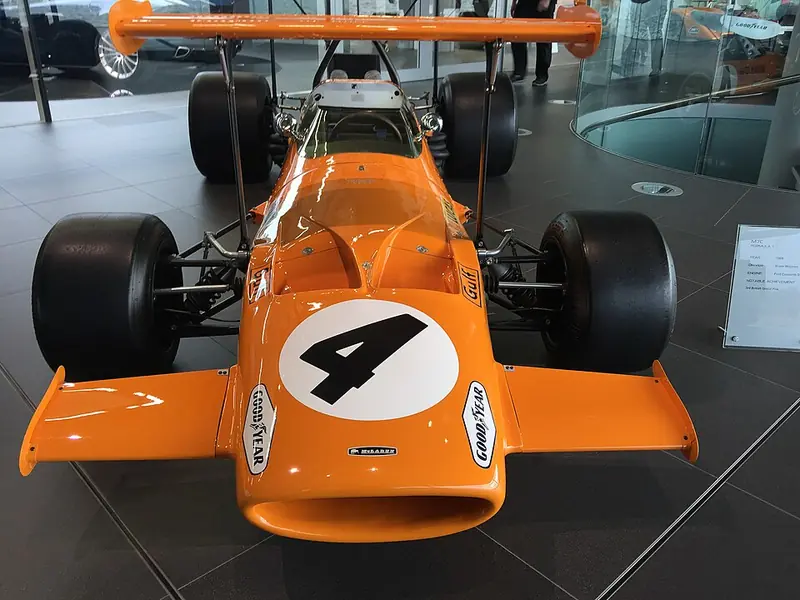
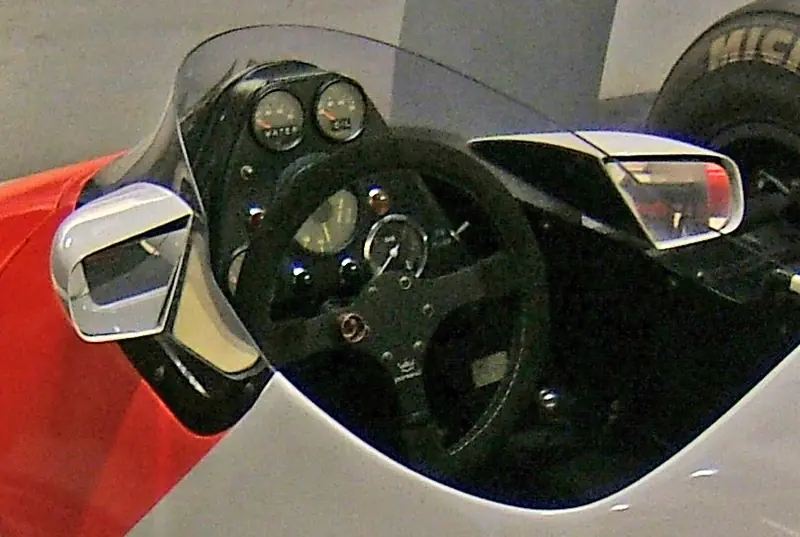
In the 1980s the wheel got a quick-release mechanism: it could be taken off, and cockpits became tighter.34 Radio and "boost" buttons appeared at the same time. Senna's 1988 McLaren wheel had only those two.34 Stefan Johansson called the suede rim, which gave better feel of the car, the first "real improvement".1one source: 4
The turning point came in 1989. John Barnard's Ferrari 640 was the first car in Formula 1 with a semi-automatic gearbox and paddles behind the wheel. The gear lever and the clutch pedal were gone.101211 Barnard first proposed two buttons on the wheel; it was Piero Lardi Ferrari who suggested paddles.1one source: 10 On 26 March 1989 Nigel Mansell won the Brazilian Grand Prix in the 640 on its debut.101217 Gerhard Berger recalled:
"For the first time, you had both hands on the steering wheel, you could shift in corners."1one source: 11
According to Berger, a manual gearbox at Monaco meant around 1,500 gearshifts a race, with the driver steering one-handed 80% of the time.1one source: 11 By the mid-1990s every team had a semi-automatic gearbox. McLaren switched with the MP4/7 in 1992.12113
Around then the wheel gained a pit lane speed limiter and rotary switches for settings.34 The display long sat separately, on the front bulkhead of the cockpit, and on the McLaren it moved onto the wheel in 2009 to save weight.34 A large LCD screen with menus of data arrived in 2014 along with the hybrid engines.34
The start: the clutch at your fingertips
There is no clutch pedal; at the start the driver releases a paddle on the wheel. The 2026 regulations allow at most two clutch paddles, both pulled towards the driver, with no more than 80 mm of travel at the tip.159 Since 2016 the FIA has banned paddles with a pre-programmed bite point, so the driver now finds the moment the clutch "bites" with their fingers.159 At McLaren, Lando Norris practised starts while sitting in the car before going out: the lights on the wheel's screen go out as at a race start, and he releases the clutch exactly as far as the engineers ask.1one source: 18
The rules also require a quick release: with belts fastened, the driver must remove the wheel and get out of the car within 7 seconds, then put the wheel back within 12 seconds in total.1one source: 15
Where the sources disagree
Sources
Footnote numbers are the numbers of the sources in this list.
- Mercedes-AMG Petronas F1 Team, 2023-10-09: “How Does an F1 Steering Wheel Work? (2019 Mercedes wheel)”
- Ferrari, 2019-10-23: “Explained: Ferrari SF90 steering wheel”
- McLaren, 2014-10-29: “Through the ages: Formula One steering wheels”
- Motorsport.com, 2024-01-01: “F1 steering wheels: How they work, what the buttons do and more”
- Motor Sport Magazine, 2025-01-14: “How much does an F1 car cost?”
- PlanetF1, 2023-08-03: “Revealed: The staggering cost of a modern day Formula 1 car”
- Motorsport.com, 2022-04-06: “Insider's guide: How is an F1 car made?”
- Formula1.com, 2021-06-08: “TECH TUESDAY: What is the 'magic' brake setting that cost Hamilton in Baku (Mark Hughes, Giorgio Piola)”
- Formula1.com, 2018-04-24: “TECH TUESDAY: Why Vettel's Ferrari steering wheel continues to evolve (Mark Hughes, Giorgio Piola)”
- Motorsport.com, 2021-06-04: “The troubled Ferrari that was a game-changer for F1 (Matt Somerfield, Giorgio Piola)”
- Goodwood Road & Racing, 2024-04-14: “Gerhard Berger on the flawed genius of his 1989 Ferrari 640 (Ethan Jupp)”
- Formula1.com, 2025-03-05: “The 75 best drivers, cars, innovations, teams and key figures in F1 history”
- McLaren, 2026-01-16: “Introducing F1's new terminology: Boost Button, Overtake Mode, Active Aero, and Recharge”
- Formula1.com, 2025-12-17: “EXPLAINED: The key terms for Formula 1's new-for-2026 rules”
- FIA, 2026-04-28: “2026 F1 Regulations — Section C: Technical, Issue 17 (Art. C9.2, C12.5)”
- Jolpica F1 API, 2021-06-06: “Jolpica F1 API: 2021 Azerbaijan GP results”
- Jolpica F1 API, 1989-03-26: “Jolpica F1 API: 1989 Brazilian GP results”
- McLaren, 2020-09-24: “How Carlos Sainz and Lando Norris improve their reaction times”