There is no price tag
Ask a Formula 1 team what its car costs and you will not get a precise answer: teams keep part prices to themselves, so every figure below is an estimate by journalists and engineers.14 Pat Symonds, a former Formula 1 chief technical director, who helped Motor Sport put together a cost breakdown of a car, began with an admission:
Even the totals differ several times over. Red Bull estimated a car at roughly €15m in 2022, Motor Sport arrived at $20.6m in 2025, and Motorsport.com in 2023 quoted a "guesstimate" of around £6m, while warning that it was unclear what that figure included.?sources disagree: 213 So what follows goes part by part, with a year and a source next to every number.
The engine: the most expensive part
The Power unitThe combustion engine together with the electrical part and the battery.In the glossary → costs the most.43 Customer teams do not buy engines one at a time: they pay the manufacturer for a season's supply, and the FIA caps that price. In the 2025 Technical Regulations the maximum supply price is €15m.54 Motor Sport gave a different version in January 2025: the regulations supposedly call for €12m, while customers actually pay around €15m.?sources disagree: 15
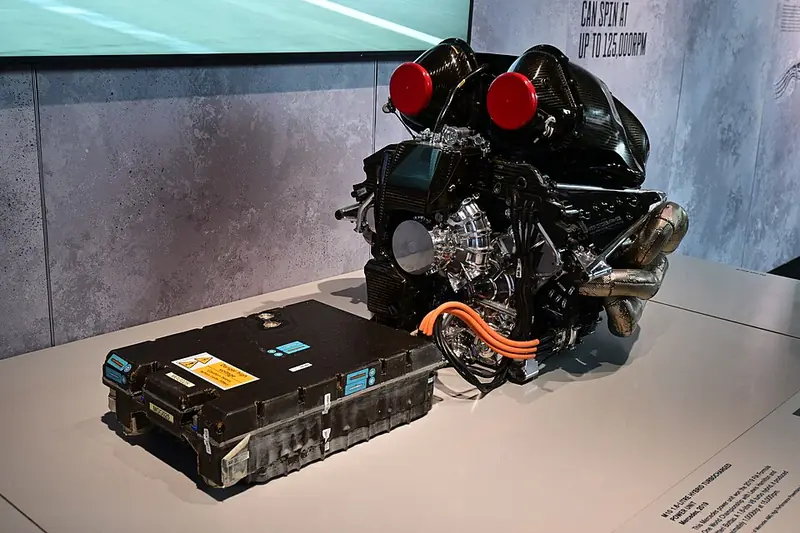
Where did €12m come from? In January 2016 Autosport reported that the four manufacturers had agreed to cut the supply price of the hybrid V6s to €12m a season. At the time, smaller teams were paying €20–25m a year.1one source: 6 The FIA's official decision in April 2016 was more cautious: €1m off in 2017 compared with 2016, and a further €3m off from 2018.1one source: 7
New engines arrived in 2026, and the ceiling went up. The FIA regulations set a maximum of €22m adjusted for indexation, and €20.75m from 2027.1one source: 8 Back in the summer of 2025, Autosport, citing paddock sources, wrote that one major supplier had warned its customers that prices would double.1one source: 9
How much one physical unit costs is a separate question, and this is where the estimates diverge most. Red Bull spoke of €10m per power unit in 2022. Motorsport.com in 2023 said around £3.5m to build a single unit and about £12m a year for several. Motor Sport in 2025 said €15m "for one engine".?sources disagree: 231 Part of the gap is that some count the price of a season's contract covering several units, while others count the cost of a single power unit.?sources disagree: 231
The monocoque
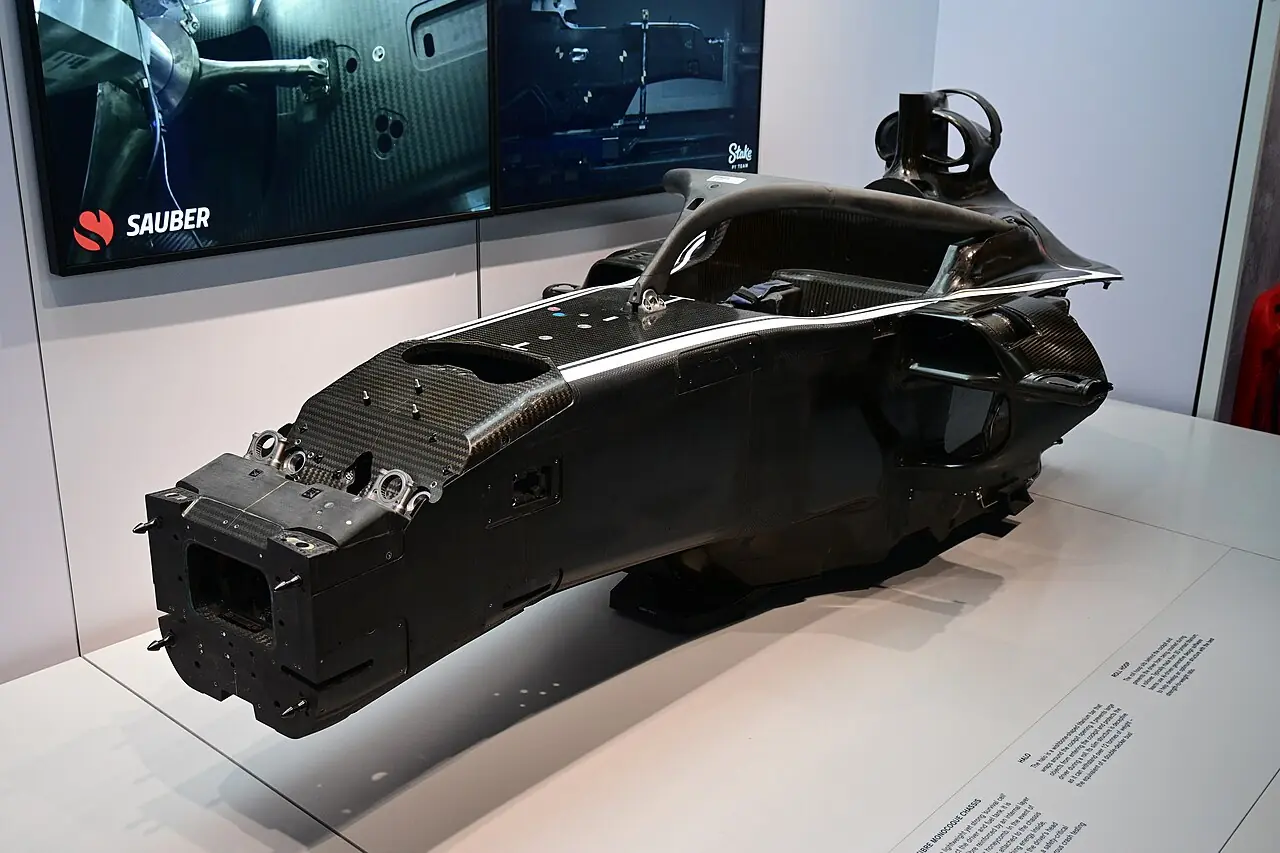
The monocoque is a single-piece carbon-composite shell that protects the driver. Motor Sport says it is usually made from 12 layers of carbon fibre mats.1one source: 1 Estimates: £500,000 from Motor Sport (2025), around €580,000 (£500,000) from PlanetF1 (2023), citing team estimates, and around £1m from Motorsport.com (2023).?sources disagree: 123
The gearbox
The gearbox is semi-automatic, with eight forward gears and one reverse; some teams buy theirs from others, some make their own.1one source: 1 Estimates of its cost run from £250,000 (Motor Sport, 2025) and £275,000 (Symonds, 2021, as reported by PlanetF1) to $400,000 (Autosport, 2024) and even £750,000 (Motorsport.com, 2023).?sources disagree: 1243
Wings
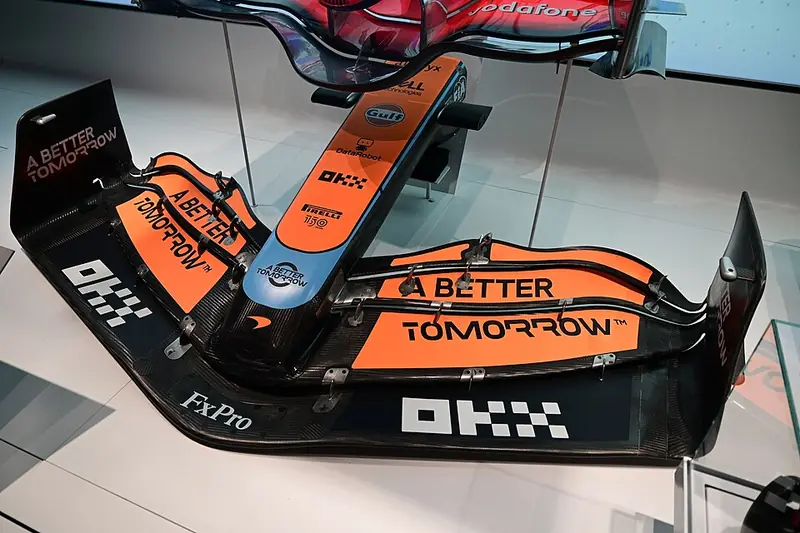
The front wing is one of the most intricate parts of the car, and according to Symonds no part of the car has got more complicated since 2016.1one source: 1 He showed how the stakes have changed:
"A Marussia front wing was £33,000."1one source: 1
For a current wing he would go with "at least £100,000".1one source: 1 Haas team principal Guenther Steiner said in 2021 that "the front wing alone is a hundred and fifty thousand" dollars, and Motorsport.com in 2023 put it at £150,000.?sources disagree: 1031 Motor Sport puts the rear wing together with the DRSDrag Reduction SystemA rear-wing flap a driver could open on set straights when less than a second behind the car ahead. Used from 2011 to 2025.In the glossary → mechanism at £61,000–108,000.1one source: 1 The floor in the same breakdown costs around £100,000, and the hydraulics £123,000.1one source: 1
Steering wheel, halo, fuel tank and tyres
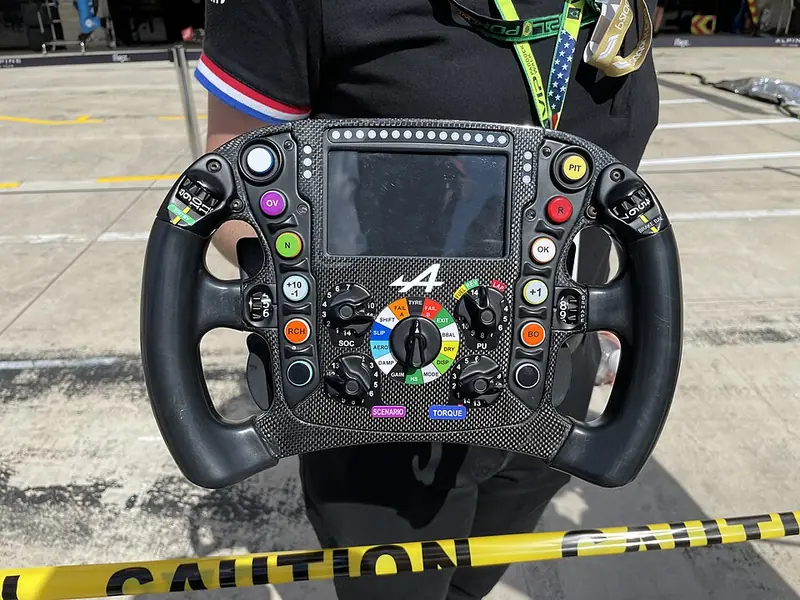
The steering wheel is carbon fibre, silicone grips and a lot of electronics.?sources disagree: 123 Motor Sport put it at £35,000 in 2025, PlanetF1, citing Symonds' 2021 column, at €50,000 (£43,000), and Motorsport.com at £50,000 in 2023.?sources disagree: 123 The halo, by Motor Sport's estimate, costs around £12,000 and the fuel tank around £22,000.1one source: 1
Symonds passed on what Pirelli's head of F1, Mario Isola, had told him: €600 per tyre.1one source: 1 Motor Sport puts a set at about $3,000.1one source: 1
Why "the price of a car" explains nothing
Motor Sport's breakdown covers manufacturing only: research and development are not included.1one source: 1 That is why Formula 1's rules limit a team's overall spending.
The cost cap was introduced in 2021: $145m, then $140m in 2022 and $135m from 2023.13144 From 2026 the cap is $215m if a season has no more than 24 rounds; each extra round adds $1.8m, plus indexation. The FIA itself converts this, for illustration, into £170m or €199m.1513 The jump is mostly an accounting one: many costs that used to be excluded were brought inside the cap, and F1 describes the change as roughly neutral.1314
What does not count against the cap: marketing, driver pay together with their travel, the pay of the team's three highest-paid people, HR, finance and legal, property, bonuses up to a ceiling, FIA fees, and the power unit supply up to that same maximum price.151413 Car parts, on the other hand, "from the steering wheel to the wheel nuts", and spares are inside the cap.1413
Engine manufacturers have their own separate cap: $95m a year in 2023–2025 and $190m from 2026.1613 Originally $130m was planned for 2026.1one source: 13
The cost of a crash
Teams pay for crash repairs out of their own cap, so a wrecked car is money that will be missing for upgrades.1114 Mercedes estimated the bill for Valtteri Bottas's car, wrecked at Imola in 2021, at around £1m.1one source: 11 Steiner, the same year, put the repairs after a Mick Schumacher crash at $300,000–500,000.1one source: 10 The Race calculated that three Williams crashes in early 2024 would cost the team more than $2m.1one source: 12
When a car does get sold
A Formula 1 car only gets a real price tag at auction. The Mercedes W04 in which Lewis Hamilton won the 2013 Hungarian Grand Prix was sold by RM Sotheby's in Las Vegas during the 2023 Grand Prix for $17.1m plus a 10% buyer's premium, about $18.8m (£15.1m) in total.174 That is almost as much as Motor Sport's estimate for building a new car.?sources disagree: 213174 The buyer was paying for the history of that particular car. Older cars cost even more. In 2013, at the Goodwood Festival of Speed, Juan Manuel Fangio's 1954 Mercedes sold for £19.6m, a record at the time according to Autosport.1one source: 4 That record fell in February 2025: a 1954 Mercedes-Benz W 196 R Stromlinienwagen went for €51.155m at RM Sotheby's in Stuttgart, the most expensive Grand Prix car ever sold at auction.1819
Where the sources disagree
According to PlanetF1, Red Bull put a car at about €15m in 2022. Motor Sport arrived at $20.62m in 2025, while Motorsport.com in 2023 offered a rough guess of around £6m and itself warned that it was unclear what the figure included. [2, 1, 3]
Motor Sport wrote in January 2025 that the regulations set €12m while customers actually pay around €15m. The FIA's 2025 Technical Regulations put the maximum supply price at €15m; according to Autosport, €12m was the figure in the manufacturers' 2016 agreement. [1, 5]
PlanetF1 relays Red Bull's 2022 estimate of about €10m per power unit. Motorsport.com in 2023 wrote of £3.5m for a single unit and about £12m a year for several, Motor Sport in 2025 of €15m "for one engine". Part of the gap is that some count the price of a season's supply of several units, others a single unit. [2, 3, 1]
Motor Sport (2025) puts the monocoque at £500,000, PlanetF1 (2023), citing team estimates, at around €580,000 (£500,000), and Motorsport.com (2023) at around £1m. [1, 2, 3]
Motor Sport (2025) gives £250,000, PlanetF1, relaying Pat Symonds in 2021, around €320,000 (£275,000), Autosport (2024) around $400,000 and Motorsport.com (2023) £750,000. [1, 2, 4, 3]
In 2021 Haas team principal Guenther Steiner, as quoted by RaceFans, said the front wing alone cost a hundred and fifty thousand; he did not name a currency, and RaceFans gives the figures in dollars. Motorsport.com (2023) puts the wing at £150,000, Motor Sport (2025) at £100,000. [10, 3, 1]
Sources
Footnote numbers are the numbers of the sources in this list.
- Motor Sport Magazine, 2025-01-14: “How much does an F1 car cost?”
- PlanetF1, 2023-08-03: “Revealed: The staggering cost of a modern day Formula 1 car”
- Motorsport.com, 2023-02-19: “Insider's guide: How is an F1 car made?”
- Autosport, 2024-04-03: “How much does an F1 car cost, and other F1 questions answered”
- FIA, 2025-04-07: “2025 Formula 1 Technical Regulations, Issue 03 (Appendix: power unit maximum supply price)”
- Autosport, 2016-01-19: “Manufacturers agree customer cost cap”
- Formula1.com, 2016-04-29: “FIA confirms revised engine regulations for 2017”
- FIA, 2026-06-25: “2026 F1 Regulations — Section A: General Regulatory Provisions, Issue 03 (Appendix A7 §1.4; Appendix A9)”
- Autosport, 2025-07-30: “FIA agreement on TPC testing in F1, but will power unit costs double in 2026?”
- RaceFans, 2021-05-23: “Schumacher crash damage cost Haas up to half a million dollars”
- Motorsport.com, 2021-04-26: “How a million pound crash highlighted F1's money squeeze”
- The Race, 2024-04-09: “The brutal cost of Williams's shocking F1 crash streak”
- Formula1.com, 2026-04-10: “EXPLAINED: What is the F1 cost cap and why has it gone up?”
- Autosport, 2025-10-28: “All to know about the F1 cost cap”
- FIA, 2026-06-25: “2026 F1 Regulations — Section D: Financial Regulations (F1 Teams), Issue 07 (Art. D4.1.2, D5.1.1)”
- FIA, 2026-05-07: “2026 F1 Regulations — Section E: Financial Regulations (PU Manufacturers), Issue 05 (Art. E2.3.1)”
- Crash.net, 2024-01-23: “Lewis Hamilton's first race-winning Mercedes F1 car sold for astonishing $18.8 million”
- RM Sotheby's, 2025-02-01: “Most valuable Grand Prix car ever sold: the 1954 Mercedes-Benz W 196 R Stromlinienwagen sells for €51,155,000”
- Motor Sport Magazine, 2025-02-01: “Mercedes streamliner sells for €51m, becoming most expensive F1 car ever auctioned”