On TV, a Formula 1 team is two drivers, a boss on the pit wall and twenty mechanics in the garage. In reality each car is backed by hundreds of people, and at the big teams by well over a thousand. Here is how many there are, what they do and what the budget cap did to them.
From a few hundred to over a thousand
Motorsport.com gives the general frame: an F1 team directly involves between 300 and 1,200 people.1one source: 1 More precise numbers can be found at Companies House, the UK company register. Most teams are based in England and file annual accounts there that include their average headcount.
At Mercedes-Benz Grand Prix Ltd, the company behind the Mercedes team, an average of 1,348 people were employed in 2025: 998 in design, manufacturing and engineering and 350 in administration. A year earlier the figure was 1,323.1one source: 2 Mercedes engines are built by a separate company, Mercedes AMG High Performance Powertrains. In 2025 it employed another 886 people on average, 796 of them in production. The same company supplies Power unitThe combustion engine together with the electrical part and the battery.In the glossary → to McLaren, Aston Martin and Williams and carries out R&D for road cars.1one source: 3
The Red Bull Technology group, whose accounts consolidate Red Bull Racing Ltd, averaged 1,100 employees in 2025: 456 in racing and production, 303 in design and 341 in administration. In 2024 there were 969.1one source: 45 Williams Grand Prix Engineering reported 1,151 people in 2025 (765 in research and development, 300 in administration and support, 86 in marketing), against 949 a year earlier.1one source: 6
At the opposite end sits Haas. In December 2025 PlanetF1 reported that the team's staff count had grown from 230 to around 380 in two years. In November 2026 Autosport put it at "around 400", still by far the smallest operation on the grid.78
These numbers are not fully comparable: each group splits its people between companies in its own way, and the categories in the accounts differ. But the order of magnitude is clear: a big team is more than a thousand people, the smallest a few hundred.
Who works at the factory
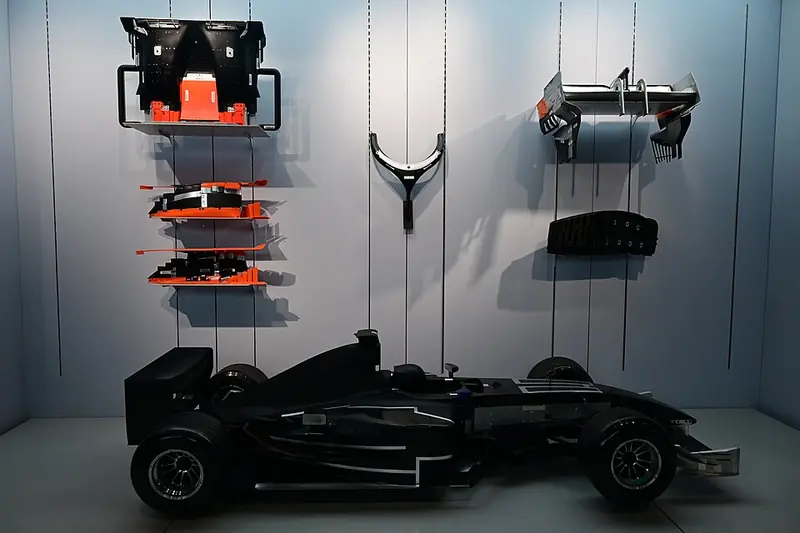
Most of these people never go to a race. Motorsport.com describes a typical factory like this: a design office with aerodynamics split into three or four sub-teams; a simulation department that covers more than 100,000 virtual kilometres a year; manufacturing; test and development; and a race bay where cars are stripped, cleaned and rebuilt between races.1one source: 1 The factory keeps working on race weekends too: at Mercedes, strategists sit in the Race Support Room in Brackley.1one source: 9
Who goes to the track
By Motorsport.com's estimate, around 75 people travel to each race.1one source: 1 Those who work directly on the cars are limited by the Sporting Regulations. In 2025 a team could have no more than 58 "operational" personnel at the circuit; for 2026 the limit was raised to 60. According to the FIA, the change is meant to let teams operate the new generation of cars effectively.101112
The limit applies from 29 hours before the first practice session until two hours after the start of the race. Only in the window from 45 minutes before the first Formation lapA slow lap before the start to warm the tyres and check the systems.In the glossary → until 15 minutes after the start is the number of people unlimited.1one source: 1011 Drivers, as well as hospitality, marketing, media, security staff and truck drivers, do not count towards the limit.1one source: 11 Separately, each team gets 16 exceptions per season for trainees, but no trainee may attend more than three events in that capacity.1one source: 1011
In the pandemic year of 2020 the rules were stricter: at events without spectators a team was allowed 80 people, 60 of them operational, and from the Belgian Grand Prix the limit was raised to 90.1one source: 13
Among those who travel are the engineers. Mercedes has around 15 to 20 engineers at the track. The race engineer is the link between the team and the driver, the performance engineer works alongside him analysing telemetry, and separate engineers look after the electronics and the power unit.1one source: 9
The pit stop: twenty-odd pairs of hands
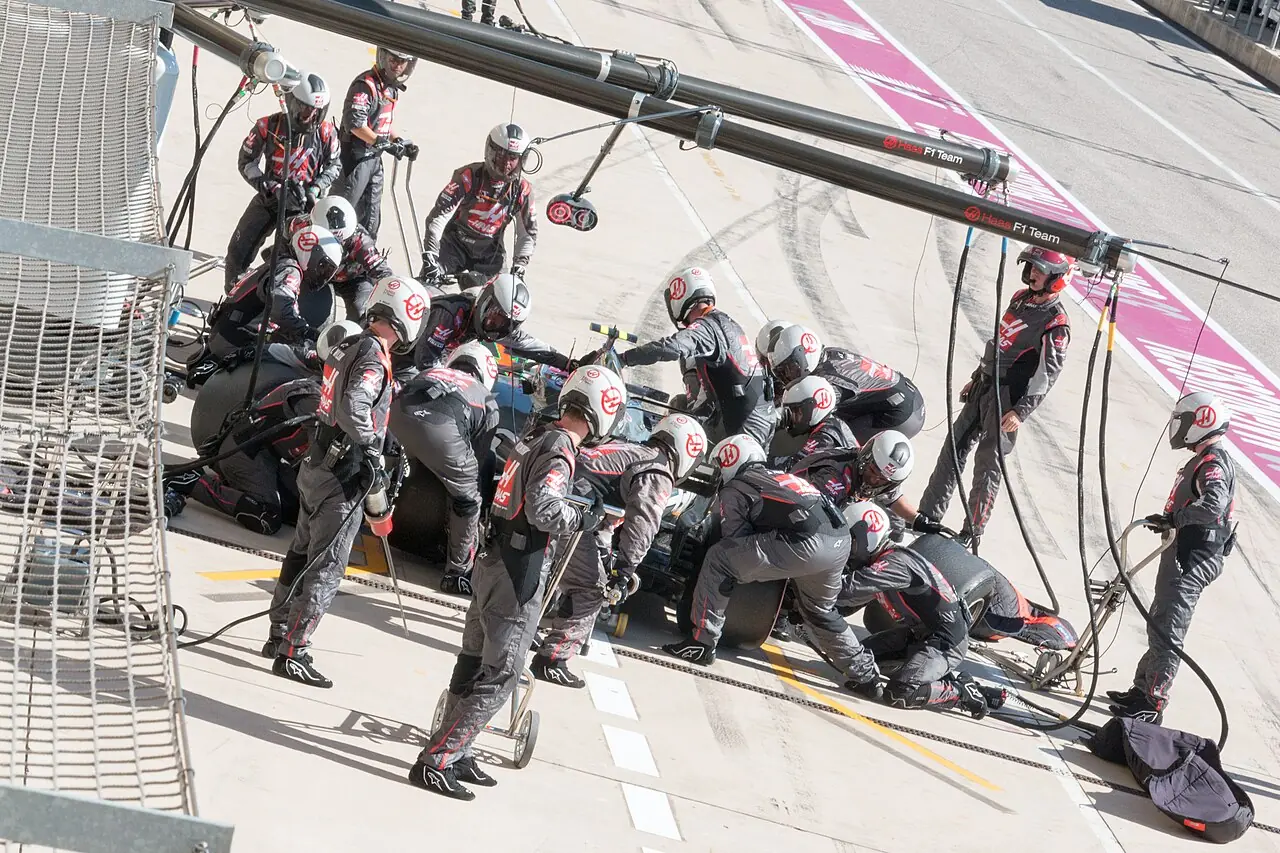
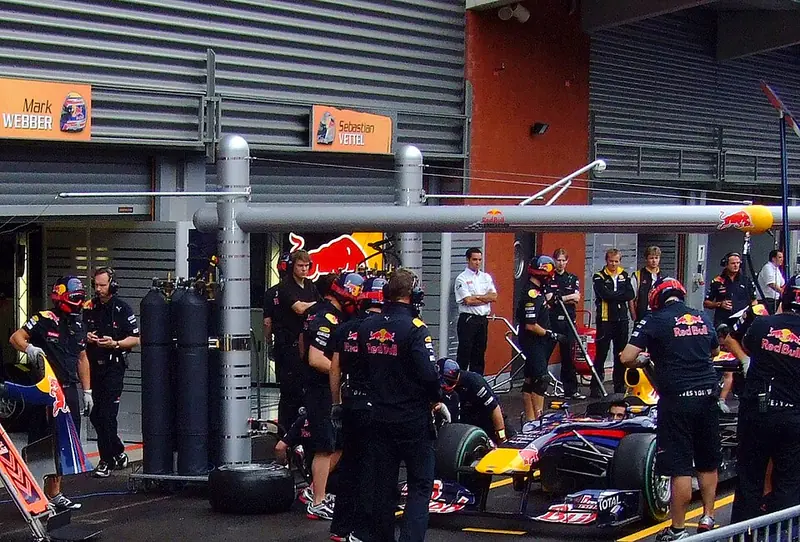
More than 20 people take part in a Pit stopA stop in the pits, most often to change tyres.In the glossary →. One lifts the car on the front jack, another on the rear jack. Four operate wheel guns, four remove the old wheels and four more fit the new ones. Two hold the car steady, two adjust the front wing, and one controls the release.1415 In 2019 F1.com described a Williams crew of 23 people including reserves.1one source: 15
This is not a separate profession. Almost everyone in the pit crew is a mechanic with another job in the team.1415 They train a lot: before the 2019 season Williams practised more than 1,200 pit stops on a rig.1one source: 15 The fastest pit stop in history took 1.80 seconds: McLaren serviced Lando Norris's car at the Qatar Grand Prix on 8 October 2023.1617
What the budget cap did
The spending cap in force since 2021 hit the workforce of the big teams first. At Mercedes, average headcount fell from 1,063 in 2020 to 1,004 in 2021. Design, manufacturing and engineering lost people, going from 906 to 831, while administration actually grew, from 157 to 173.1819
Sources disagree on how many people left Mercedes: GP Racing reported "just under 50" in 2021, while Crash.net later gave 59.?sources disagree: 2021 At Red Bull, according to Motorsport-Total.com figures relayed by Crash.net, 154 people were made redundant at Red Bull Racing and Red Bull Technologies in 2020–2021, though not all of them worked for the F1 team.1one source: 21
Red Bull boss Christian Horner said in April 2021 that the team's staff numbers were now "in the 800s" and that it had gone through "the pain of redundancies" over the winter. Toto Wolff admitted it had been no easier at Mercedes:
"You cannot secure your capability in terms of people if you suddenly have to operate under a drastic cost cap."1one source: 22
Some people were moved rather than let go. The Financial Regulations do not count spending on non-F1 activities, or on the HR, finance and legal functions, towards the cap.1one source: 23 In 2021, 30 Mercedes staff worked on an America's Cup yacht, while Ferrari moved Scuderia specialists onto road-car development.1one source: 20
Within a few years the numbers were climbing again. In 2025 Mercedes employed 1,348 people, more than before the cap, 350 of them in administration, twice as many as in 2021.1one source: 21819 The accounts do not say whether this is linked to the exemptions in the rules.
Where the sources disagree
Sources
Footnote numbers are the numbers of the sources in this list.
- Motorsport.com, 2023-02-19: “Insider's guide: Who does what in an F1 team?”
- Companies House (UK), 2026-06-07: “Mercedes-Benz Grand Prix Limited – Group of companies' accounts made up to 31 December 2025 (note 4: staff numbers and costs)”
- Companies House (UK), 2026-07-10: “Mercedes AMG High Performance Powertrains Limited – Full accounts made up to 31 December 2025 (notes 1.10, 4)”
- Companies House (UK), 2026-10-05: “Red Bull Technology Limited – Group of companies' accounts made up to 31 December 2025 (note 8: staff costs)”
- Companies House (UK), 2026-10-05: “Red Bull Racing Ltd – Full accounts made up to 31 December 2025 (note 2: consolidated into Red Bull Technology Ltd)”
- Companies House (UK), 2026-09-22: “Williams Grand Prix Engineering Limited – Group of companies' accounts made up to 31 December 2025 (note 4: particulars of employees)”
- PlanetF1, 2025-12-17: “Revealed: What Toyota really wants to gain from its Haas F1 partnership (Thomas Maher)”
- Autosport, 2026-11-04: “What's the state of play at F1's smallest team? (Jake Boxall-Legge)”
- Mercedes-AMG Petronas F1 Team: “Insight: The trackside engineers”
- FIA, 2025-04-30: “2025 Formula 1 Sporting Regulations, Issue 5 (Article 23)”
- FIA, 2026-06-25: “FIA 2026 F1 Regulations – Section B: Sporting, Issue 07 (Article B9)”
- Motorsport Week, 2025-12-10: “FIA confirms various temporary changes for 2026 F1 season (Jack Oliver Smith)”
- Motorsport.com, 2020-08-26: “Rule tweak allows more team personnel at races (Adam Cooper)”
- Motorsport.com, 2022-02-08: “Insider's guide: Why are F1 pit stops so fast?”
- Formula1.com, 2019-10-06: “Gone in 1.88s: Putting together the perfect F1 pit stop (Lawrence Barretto)”
- Guinness World Records: “Fastest Formula One pit stop”
- Carscoops, 2023-10-11: “McLaren breaks pit stop world record with 1.80-second tire change at Qatar GP (Andrew Gutman)”
- Companies House (UK), 2022-10-07: “Mercedes-Benz Grand Prix Limited – Full accounts made up to 31 December 2021 (note 5: employees)”
- BlackBook Motorsport, 2022-10-10: “Mercedes F1 sees 2021 profits increase by US$61m (Cian Brittle)”
- Autosport, 2021-07-04: “How the cost cap is putting new pressures on F1's top teams (Mark Gallagher, GP Racing)”
- Crash.net, 2024-01-23: “Explained: Red Bull made 154 redundancies due to F1 cost cap (James Dielhenn)”
- GPFans, 2021-04-02: “Wolff and Horner reveal "pain" of axing staff to accommodate F1 budget cap (Ian Parkes)”
- FIA, 2024-12-11: “Formula 1 Financial Regulations, Issue 22 (Article 3: exclusions)”